
Manga batch colorizer cost is the full cost of a usable chapter result: credits, failed-page retries, review time, manual corrections, file preparation, and final handoff. A low per-page price can still be expensive when the source is inconsistent or when the output requires structural repainting.

Short answer
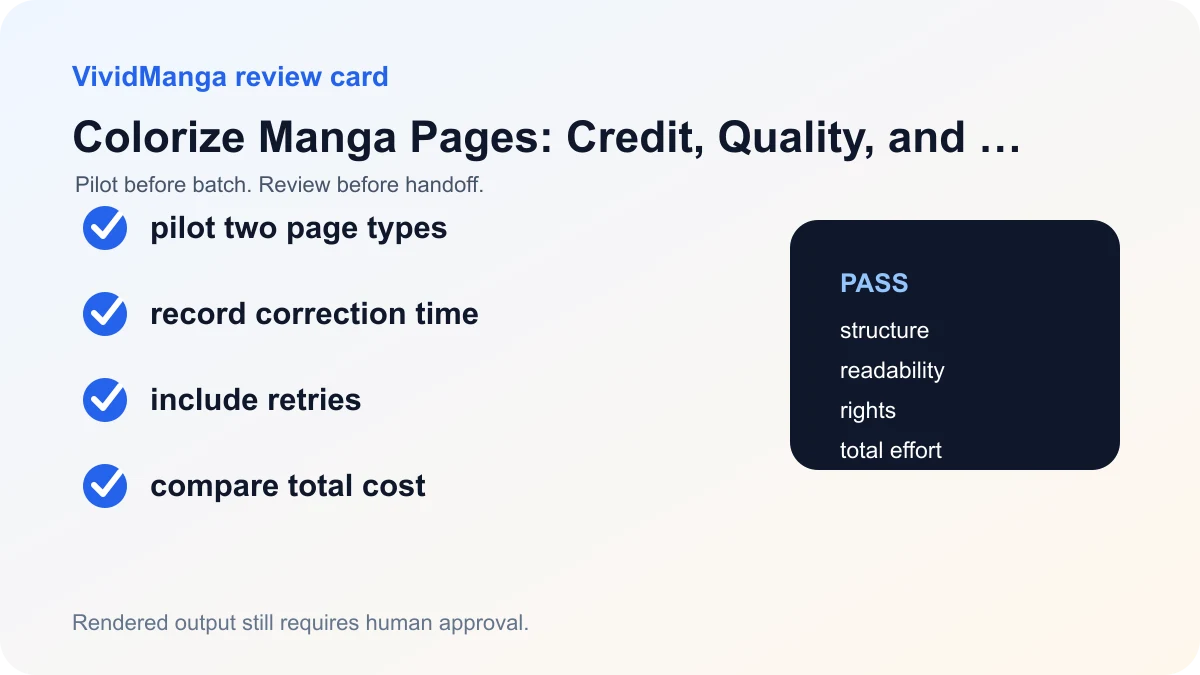
Estimate a chapter from a two-page pilot: one ordinary page and one difficult page. Record the credits used, inspection time, correction time, and number of pages that would need a rerun. Compare that total with your manual baseline or a colorist quote. Scale only when the test saves effort without weakening the final work.
A five-step workflow
1. Separate price from cost
The checkout price buys processing capacity. Production cost also includes organizing pages, checking rights, reviewing results, fixing errors, and returning the files to the project.
Write those tasks down before the pilot so a fast preview does not hide a slow correction cycle.
2. Test ordinary and difficult pages
An ordinary page estimates the common case. A difficult page exposes the expensive tail: dense tone, crowds, complex hair, tiny effects, dark scenes, or several recurring colors.
If the difficult page fails structurally, do not average it away. Chapters are delayed by exceptions, not by the easiest page.
3. Track credits and labor together
Record credits submitted, credits restored or refunded after failures if any, review minutes, correction minutes, and any export or naming work. Use the same categories for manual coloring or an outside colorist.
The comparison should reflect accepted output. Do not stop the timer when the model finishes if a person still has to repair the page.
4. Price continuity risk
A batch can create extra work when recurring hair, skin, costumes, props, or lighting move between pages. Review a short sequence before multiplying the single-page estimate by the chapter count.
If continuity repair is systematic, a color reference or a manual flats pass may reduce total cost more than additional automated runs.
5. Choose the right production split
Use automation for the parts it handles reliably and keep interpretive lighting, atmosphere, materials, and final approval with the artist or colorist.
For some projects the tool is a first pass. For others it is only a palette reference. The cheaper option is the one that reaches an accepted page with the least total effort.
Decision table
| Cost layer | Measure | Evidence |
|---|---|---|
| Processing | Credits consumed for accepted pages | Current pricing and job estimate |
| Review | Time to inspect sequence and defects | Pilot timer |
| Correction | Time to repair or recreate output | Editing log |
| Risk | Continuity, rights, confidentiality | Project brief and policy review |
Current VividManga credit basis
Checked August 27, 2026: one single-page generation costs one credit, and a batch job also estimates one credit for each detected page. Current live one-time packs are 100 credits for $4.99, 250 for $9.99, and 800 for $24.99. Monthly plans currently provide 400 credits for $9.90, 1,000 for $19.90, or 2,500 for $39.90. Yearly plans are also available. Prices and plans can change, so use the live pricing section for a purchase and keep the date beside any project estimate.
At the one-time pack rates, the generation-only unit price is about $0.0499, $0.0400, or $0.0312 per credit. That is not the accepted-page cost. The formula is:
accepted-page cost = (credit spend + review labor + correction labor + overhead) / accepted pages
Use labor in the same currency. If a 20-page pilot uses 20 first-pass credits, 4 retry credits, 40 minutes of review, and 80 minutes of correction, it consumes 24 credits and two hours of labor. With the 100-credit pack, the credit component is about $1.20. At a $30 hourly internal labor rate, labor adds $60, so the accepted-page cost is about $3.06 before overhead. The example is intentionally simple and does not represent a quoted service price.
Copyable worksheet
| Input | Example | Your job |
|---|---|---|
| Source pages | 20 | |
| First-pass credits | 20 | |
| Retry credits | 4 | |
| Accepted pages | 20 | |
| Review hours | 0.67 | |
| Correction hours | 1.33 | |
| Internal hourly rate | $30 | |
| Credit-pack unit price | $0.0499 | |
| Overhead | $0 | |
| Accepted-page cost | $3.06 |
Project a chapter by separating ordinary and difficult pages. If 80 ordinary pages average one credit and four correction minutes, while 20 difficult pages average 1.5 credits and fifteen correction minutes, do not multiply a single average from an easy cover. Calculate the two groups, then add archive preparation, art direction, approval, and handoff.
Compare equivalent deliverables
An automated render and a professional colorist quote are rarely the same scope. Ask whether the quote includes flats, controlled palettes, lighting, effects, lettering protection, layered files, revisions, continuity review, art direction, prepress, and commercial usage terms. VividManga supplies a rendered image, not editable color layers. A lower generation line item may still be the wrong choice when layered delivery or substantial repainting is required.
The break-even point is where accepted-page cost and delivery risk are better than the alternative for the same scope. Stop scaling when repeated structural fixes erase the time saved, when retry rate rises across a chapter, or when the rights and privacy terms do not fit the source.
Only upload material you own or have permission to process. Check the Privacy Policy and Terms of Service before estimating confidential client work. Credits restored after a technical failure depend on the current policy and job state; do not assume every disliked output is refunded.
Colorize one manga page here
Upload one black-and-white page, get a color result, then decide whether to process more pages.
PNG, JPG, or WebP under 5 MB works best.
Use this result to judge palette, line art, and speech bubbles before scaling.
Use Colorize Manga Pages to confirm the detected count and displayed estimate. Keep this worksheet beside the batch workflow and update the price basis on purchase day.
Model retries as a rate, not a surprise
After a representative pilot, estimate retry rate as retry credits divided by first-pass pages. A 10-page pilot with two reruns suggests a 20 percent retry-credit assumption, but the sample is small. Add a margin when the full chapter has more night scenes, detailed crowds, or repeated costumes than the pilot. Keep structural rejects separate from simple preference reruns because their correction costs differ.
Track accepted yield as accepted pages divided by attempted unique pages. If 20 unique pages use 24 credits and only 18 are accepted, credit cost per accepted page uses 24 divided by 18, not 24 divided by 20. Add the remaining two pages' manual completion cost to the project total. This prevents rejected outputs from disappearing from the estimate.
Plan choice also affects unused credits and timing. A subscription can lower the nominal unit price but may be wrong for a one-off chapter if credits are not needed later. A one-time pack can leave a balance that lowers the effective cost of the next project only if that future use is real. Record the purchase, allocated credits, credits actually consumed, and remaining balance separately. The batch returns a rendered image, not a layered color file, so price any required layer reconstruction as correction labor.
Report a range, not a false point estimate
Build a low case from the ordinary-page pilot and a high case from the difficult pages. Vary retry rate, correction minutes, hourly rate, and accepted yield. A useful budget might say $2.40 to $4.10 per accepted page under the stated assumptions instead of promising $3.06. Show the inputs beside the range.
After the first production scene, replace assumptions with actuals. Reforecast the remaining pages and compare the new accepted-page cost with the manual alternative. If the high case crosses the project's budget or deadline, reduce scope or stop before the remaining credits and review hours are committed.
Separate sunk cost from the next decision. Credits and review time already spent explain the pilot, but they do not justify a larger batch. Estimate only the remaining work, then choose the lower-risk path from that point. This keeps an attractive first result from turning an uneconomic test into a full-chapter commitment.
References used for this guide
- Clip Studio Paint Page Manager guide: The Page Manager supports page reordering, multi-page projects, reading direction, and sorting page filenames to match project order.
- Clip Studio Paint reference layer guide: Reference layers let fill and selection tools use separate line art as a boundary, which is why clean separation makes manual correction easier.
The external sources explain page-project and export mechanics rather than VividManga prices. The dated prices and one-credit-per-page basis were checked against current live configuration; worksheet results remain user-supplied estimates.
FAQ
How do I calculate manga batch colorizer cost?
Add the current processing price to preparation, review, retry, correction, and handoff time. Divide by accepted pages only after the pilot has passed.
Should I compare the tool with a colorist's page rate?
Yes, but compare equivalent scopes. A colorist quote may include flats, rendering, corrections, layered files, continuity, and art direction that a rendered automated pass does not provide.
Do failed pages count?
They count as production cost. Credits may or may not be restored under the current policy and job state, while inspection, queue time, source repair, and resubmission still use labor.
Where can I see the current VividManga price?
Use the live pricing and batch estimate shown in the product. Do not rely on a fixed number in an article because plans and credit packages can change.